 719-451-7469
 CALL US NOW
 EMAIL US NOW

Colorado Springs Restraining Order Defense Attorneys
A civil protection order issued against you is more than a court document. It can remove you from your home, restrict contact with your children, affect your employment, and, when the statutory requirements are met, restrict your ability to possess or purchase firearms. A temporary protection order may be issued after an ex parte hearing, before the respondent has an opportunity to be heard.
If a protection order has been filed against you in El Paso County, the time to act is now. Our attorneys at The Lux Law Firm defend clients across Colorado Springs, including those stationed at Fort Carson, Peterson Space Force Base, and the Air Force Academy, against restraining orders and the criminal charges that can follow. Call 719-451-7469 for a free consultation.
How Colorado Classifies Protection Orders
Colorado courts issue two primary types of protection orders: a temporary civil protection order granted ex parte (without the other party present), and a permanent protection order entered after a full court hearing where both sides may present evidence.
Understanding the distinction matters enormously for your defense strategy.
- Temporary Civil Protection Order (TPO): A judge or magistrate may issue a temporary civil protection order after an ex parte hearing, before the respondent has an opportunity to present evidence. The hearing on whether to make the order permanent generally must be set within fourteen days after issuance of the temporary civil protection order and citation, subject to statutory extensions and continuances. Despite being temporary, violation of a protection order can carry criminal consequences.
- Civil Protection Order (Permanent): After the temporary protection order, both parties appear at a hearing. The petitioner must prove their case by a preponderance of the evidence, meaning it is more likely than not that the statutory requirements for protection have been established. If the statutory requirements are met, the court may make the temporary order permanent or enter a permanent civil protection order with different provisions. A permanent protection order generally has no automatic expiration date, although Colorado law provides procedures for modification or dismissal in appropriate circumstances.
- Criminal Protection Order: Colorado courts also issue criminal protection orders as a condition of bond or sentencing in criminal cases, including domestic violence cases. These are tied to a pending criminal case, not a separate civil filing, and the protected person does not have independent authority to terminate the order.
- Civil Protection Orders Outside Domestic Relationships: Colorado civil protection orders are not limited to domestic abuse situations. Depending on the circumstances, they may also be available to address conduct such as stalking, harassment, sexual assault, unlawful sexual contact, or other conduct covered by Colorado’s protection-order statutes.
Each type follows a different procedural path under Colorado Revised Statutes § 13-14-101 et seq., and each demands a different defense approach.
What a Protection Order Actually Restricts
A Colorado protection order establishes clear boundaries between the restrained person and the protected person, and violations can result in arrest and criminal charges.
The specific terms vary by case, but most protection orders issued in El Paso County include some combination of the following restrictions:
- No contact order: No phone calls, texts, emails, or social media posts directed at the protected party, even if the message is friendly or the protected person initiates contact first. The precise terms of the order control what conduct is prohibited.
- Stay-away provisions: Mandatory distance from the protected person’s home, workplace, school, or vehicle, when those locations are specifically identified in the order.
- Move-out orders: In domestic situations, you may be ordered to leave a shared residence immediately, regardless of whose name is on the lease or mortgage.
- Firearm restrictions: Certain Colorado civil protection orders require the restrained person to refrain from possessing or purchasing firearms or ammunition and to relinquish firearms or ammunition in the person’s immediate possession or control. Federal law may also prohibit firearm possession when a protection order satisfies the requirements of 18 U.S.C. § 922(g)(8). The precise restrictions depend on the type and terms of the order.
- Custody and visitation limits: A protection order can restrict or eliminate contact with your children pending a separate family court proceeding.
Knowing exactly what the order prohibits, and what it does not, is critical. Ambiguous terms in a protection order can be a source of unintentional violations.
The El Paso County Protection Order Hearing: What to Expect
At the permanent protection order hearing in El Paso County court, both the petitioner and the restrained person have the right to present evidence, call witnesses, and cross-examine the other side, making preparation essential.
The hearing can determine whether a temporary protection order becomes permanent. Here is how the process typically unfolds:
- Service of the TPO: The respondent must be properly served with the temporary protection order and citation, or otherwise have the legally required notice. If service cannot be completed within the applicable period, the court may continue the hearing and extend the temporary protection order as permitted by statute.
- Evidence gathering: Between service and the hearing date, both sides may gather documents, text messages, witness statements, social media posts, and any other relevant evidence.
- The hearing itself: The petitioner presents their case first. Your attorneys can cross-examine their witnesses and challenge the credibility of their evidence. You may then present your own witnesses and testimony.
- The judge’s decision: The court determines whether the petitioner has met the applicable legal standard. If the statutory requirements have not been established, the protection order may be denied and the temporary order dissolved. If the requirements are established, the court may enter a permanent protection order.
- Post-hearing options: If a permanent protection order is entered, it may be subject to appellate review or, in appropriate circumstances, later modification or dismissal under Colorado law.
Missing the hearing can result in the temporary protection order being made permanent by default if the respondent was properly served and the statutory requirements for default are satisfied. Because the hearing can determine whether a temporary protection order becomes permanent, consulting with an attorney before the hearing can be important.
Consequences Beyond the Courtroom
A permanent protection order in Colorado Springs can carry consequences that extend beyond the restrictions listed in the order itself, potentially affecting employment, housing, background checks, and federal rights.
Many people focus on the immediate restrictions and underestimate the longer-term consequences:
- Criminal record exposure: Violating a protection order is generally a class 2 misdemeanor in Colorado. It is a class 1 misdemeanor in specified circumstances, including when the restrained person has a prior qualifying conviction, the order is issued under C.R.S. § 18-1-1001, the basis for the order included an allegation of stalking, or the parties were in an intimate relationship.
- Records and background checks: Civil protection orders are entered into Colorado’s protection-order registry and may be accessible to law enforcement and other entities with legally authorized access. Whether a particular civil protection order appears in an employment, housing, licensing, or other background check depends on the type of check and the records searched.
- Protection order registry: Colorado maintains a central registry of protection orders that allows law enforcement to access protection-order information for enforcement purposes.
- Federal firearm prohibition: Under 18 U.S.C. § 922(g)(8), possessing a firearm while subject to a qualifying protection order can be a federal crime. This may have serious implications for military members at Fort Carson, Peterson Space Force Base, or the Air Force Academy, as well as civilians in jobs requiring firearms.
- Immigration consequences: For noncitizens, the underlying conduct and any criminal conviction associated with a protection order may have immigration consequences. Anyone concerned about immigration status should obtain advice from an attorney qualified to address the interaction between criminal, family, and immigration law.
- Employment: Jobs requiring security clearances, professional licenses, or weapons carry may be affected by a protection order, depending on the applicable rules and circumstances.
Understanding the full scope of what is at stake is why a careful, thorough defense, starting before the permanent hearing, is so important.
Common Defenses Against a Colorado Springs Protection Order
Protection orders are not automatic. The petitioner must meet the applicable legal requirements, and there are legitimate defenses available to the restrained person at the hearing.
Colorado courts apply the statutory standards applicable to the particular ground alleged for the civil protection order. Depending on the circumstances, the grounds may include domestic abuse, stalking, sexual assault, unlawful sexual contact, or other conduct identified by Colorado law. The following issues can be relevant in El Paso County cases:
- False allegations: The petitioner fabricated or exaggerated the claimed conduct. Cross-examination, contradictory records, and witness testimony can expose inconsistencies in the petitioner’s account. People involved in a breakup, custody dispute, or property conflict may make allegations that the respondent contends are false.
- Insufficient evidence: Even where some conflict occurred, the evidence may not satisfy the legal standard required for a protection order. Evidence concerning isolated arguments or other disputed conduct may be relevant to whether the statutory requirements have been established.
- No qualifying relationship or conduct: Some protection order petitions are filed outside the categories Colorado law recognizes. For example, a petitioner who is not in a domestic relationship must still establish conduct that falls within a statutory basis for a protection order, such as stalking or harassment where applicable.
- Contradictory or incomplete evidence: Evidence showing that the allegations are inconsistent with text messages, recordings, photographs, witness testimony, location records, or other reliable evidence may be relevant to whether the statutory requirements for a protection order have been established.
- Constitutional and procedural defects: Procedural defects, evidentiary problems, or failure to satisfy the statutory requirements may provide grounds to challenge a protection order at the permanent protection order hearing or, where legally appropriate, through appellate review.
Being falsely accused does not guarantee the order will be denied. Having attorneys who know how to present your defense clearly and credibly can help ensure that the court considers the evidence and applicable law.
Colorado Springs Restraining Order Violation Attorneys: When the Order Is Already in Place
If you have been accused of violating a protection order in Colorado Springs, you may face a separate criminal case, distinct from the civil restraining order proceeding, with its own penalties and constitutional protections.
A criminal protection order violation in Colorado is charged under C.R.S. § 18-6-803.5 and treated as a criminal case in El Paso County court. Common scenarios include:
- Responding to a text or call initiated by the protected person
- Being in a prohibited location or having contact with the protected person in circumstances that may violate the specific terms of the order
- A third party relaying a message on your behalf when doing so violates the specific terms of the protection order
- Ambiguous order language that you reasonably but incorrectly interpreted
The right to remain silent applies when law enforcement contacts you about a potential violation. Our attorneys represent clients in restraining order violation proceedings and work to establish context, intent, and whether the alleged conduct actually violated the specific terms of the order.
Frequently Asked Questions About Protection Orders in Colorado Springs
Can the protected person drop a protection order?
The protected party may apply to the court at any time for modification or dismissal of a civil protection order, but the court decides whether to grant the request. A criminal protection order is governed by the criminal case and applicable criminal-court procedures.
How long does a permanent protection order last in Colorado?
A permanent protection order in Colorado generally has no automatic expiration date. The restrained person may apply to the court for modification or dismissal when permitted by law, subject to statutory requirements and applicable waiting periods.
Does a civil protection order show up on a background check?
A civil protection order is not a criminal conviction. Civil protection orders are entered into Colorado’s protection-order registry and may be accessible to law enforcement and other entities with legally authorized access. Whether a particular order appears in an employment, housing, licensing, or other background check depends on the type of check and the records searched.
What happens if both parties violate the protection order?
Colorado law does not recognize mutual violation as a defense to a violation by the restrained person. Each party is independently bound by the terms of any order entered against them. If you are the restrained person and the protected person contacts you, your legal obligation is to disengage and document the contact, not to respond. The protected party contacting you does not give you legal permission to violate the order.
Can a restraining order affect my military career?
Military members stationed at Fort Carson, Peterson Space Force Base, or the Air Force Academy may face additional professional and administrative considerations when subject to a protection order. Depending on the circumstances, a protection order may affect firearms-related duties, security-clearance matters, military assignments, or other service-related requirements.
Colorado law also addresses military protection orders. As of August 12, 2026, the existence of a military protection order is relevant evidence that a court must consider when determining whether there is a risk or threat of harm for purposes of issuing a temporary civil protection order.
What is the difference between a civil protection order and a no-contact order?
A civil protection order is initiated by a private petitioner through a civil court filing. A no-contact provision may be imposed by a criminal court in connection with a criminal case, including a domestic violence case. The legal consequences of violating the order depend on the type of order and the applicable statute. Both can restrict contact with the protected person, but they arise through different proceedings and may be governed by different legal requirements.
Can I request a modification if my circumstances change?
Yes. Colorado law permits a restrained person to apply for modification or dismissal of a permanent protection order, subject to statutory requirements and waiting periods. Generally, a restrained person cannot file another motion to modify or dismiss a permanent protection order within two years after issuance of the permanent order or disposition of the restrained person’s prior modification or dismissal motion. Additional restrictions may apply, including when the restrained person has been convicted of or pleaded guilty to certain offenses against the protected person.
Speak with Our Colorado Springs Restraining Order Defense Attorneys Today
A protection order issued against you in Colorado Springs is not something to handle alone or wait out. The restraining order process moves quickly. Permanent orders are considered at hearings that generally occur within weeks, and the consequences, from firearm restrictions to criminal exposure to potential employment consequences, can be significant.
The Lux Law Firm defends clients throughout El Paso County, including those in Colorado Springs and at nearby military installations, against civil protection orders, criminal protection orders, and restraining order violations. We take the time to understand the facts of your specific situation, evaluate the evidence, and develop a defense strategy tailored to the circumstances of your case.
Call 719-451-7469 today or reach out online to schedule your free consultation with our Colorado Springs restraining order defense attorneys. The sooner we get involved, the more options you may have.

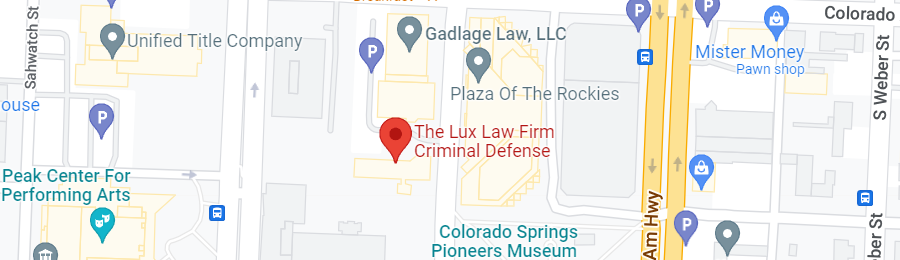
 128 S Tejon St Suite 403
 719-451-7469